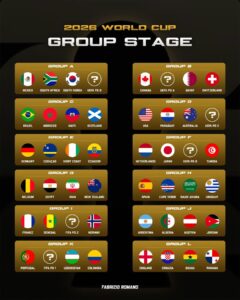
The moment football fans have been eagerly awaiting is here: the draw for the 2026 FIFA World Cup took place on 5 December 2025 at the John F. Kennedy Center for the Performing Arts in Washington, D.C. marking the official launch of the tournament’s group-stage phase.
With the tournament expanding to 48 national teams, this draw is historic — setting up 12 groups of four teams each for the first time in World Cup history.
How the Draw Works & What Changed
The draw uses a pot system: the 48 teams are divided into four pots of 12. Pot 1 includes the three host countries (USA, Canada, Mexico) plus the top-ranked teams worldwide.
Then, one team from each pot is drawn into each group — meaning every group will have a mix of top-seeded nations, rising teams, and emerging contenders.
Unique for 2026: to prevent unbalanced early match-ups, teams from the same confederation (continent) generally won’t meet — except European squads, where each group may have one or two.
Why the 2026 Draw Matters
The larger format — 48 teams instead of 32 — makes the tournament more inclusive, giving more countries a chance at global exposure and competition.
For many smaller or underdog footballing nations, this draw represents hope: a chance to shine on the world’s biggest stage and perhaps create historic upsets.
For hosts USA, Canada, and Mexico, it’s a moment of pride — they know their fate early, which helps with preparation and rallying local support ahead of the June 2026 kickoff.
What Fans Should Watch Out For
Check which groups their favorite teams end up in — group composition will shape matchups, knockout paths, and the difficulty of each team’s campaign.
Keep an eye on the play-off teams: some spots are still to be filled via inter-continental and European playoffs, and those teams were pre-allocated to Pot 4 during the draw.
The official match schedule and stadium assignments will follow soon — meaning travel plans, fan tickets, and broadcast times will take shape rapidly.
✅ Final Thought
The 2026 World Cup draw isn’t just paperwork — it’s the moment when hopes, dreams, and global rivalries take real shape. With 48 teams, new matchups, and an expanded stage across the U.S., Canada, and Mexico, this edition promises to be unlike any before. For fans everywhere: the countdown to kickoff just became a whole lot more exciting.